Executive summary
The next phase of AI for SMEs is not buying another tool. It is choosing an important process, understanding it, modelling it, turning it into a clear operating procedure and then integrating AI where it can prepare, check, route or execute work with control.
AI is now available to almost any business. There are copilots, chatbots, agents, document assistants, marketing tools, CRM connectors and increasingly capable models.
Yet many SMEs still get disappointing results. Not because there are too few tools. There are too many tools. What is missing is a connection to real work.
The European Commission estimates that almost one in five EU enterprises already uses AI, with adoption rising sharply in 2025. It also points to the barriers SMEs still face: skills, data, infrastructure and resources. Access is improving faster than implementation.
The useful question is no longer "which AI should we buy?" The useful question is:
which process is worth redesigning so that AI produces finished, measurable and controlled work?
A tool is not a system
A model can summarise. A chatbot can answer. An agent can execute steps. None of that automatically becomes a working business system.
A system needs to know where the data comes from, who can see it, which exceptions exist, when it must stop, who approves, where the action is logged and how the result is measured.
That is why so many AI pilots stall. They work in a demo, but not on Monday morning: real customers, incomplete data, permissions, urgency, owners, errors, holidays, invoices, traceability and changing requirements.
The issue is not that AI cannot help. The issue is trying to attach an intelligent tool to a process nobody has described properly.
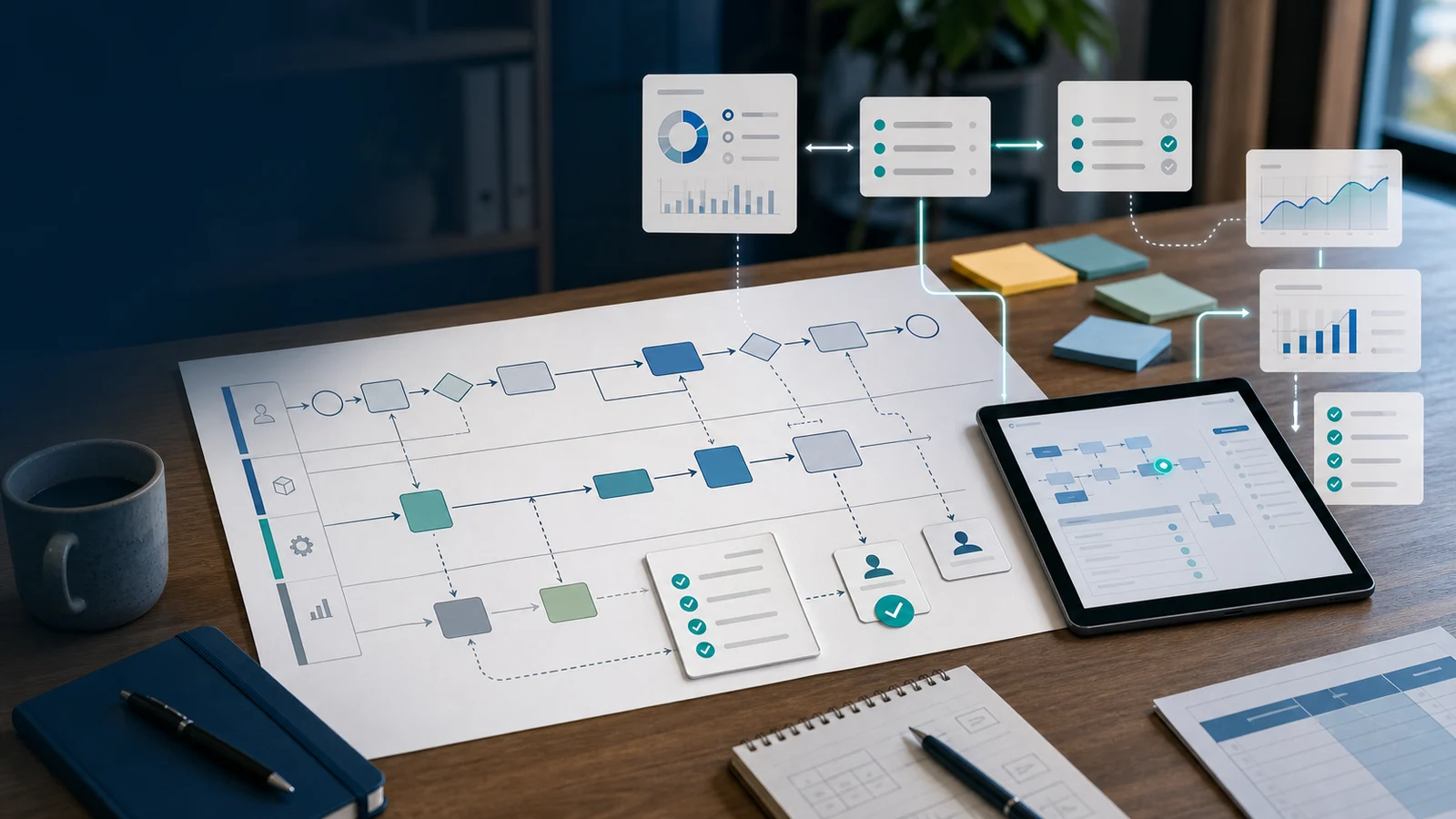
The practical route: process, BPMN, clear operating procedure, AI
At Area Europa we prefer a specific order:
business process consulting -> BPMN -> clear operating procedure -> AI-integrated workflow.
First, understand the process. Not the theoretical org chart, but the real work: what enters, what leaves, who touches each step, where it blocks, what repeats, which exceptions are common and which decisions need human judgement.
Then model it in BPMN or an equivalent process map. Not to produce documentation for its own sake, but to make the flow visible: events, tasks, decisions, waits, approvals, systems and handoffs.
Then turn it into a clear operating procedure: an operational way of working. What happens, in what order, with which data, under which criteria, with which permissions and with which expected output.
Only then does AI integration make sense. At that point it is possible to decide whether AI should read, summarise, classify, check, draft, recommend, route, update a record or act with approval.
This order may look slower at first. In practice, it saves time because it avoids automating confusion.
Where AI fits inside the workflow
The best first AI in an SME is usually not the one that "replaces" a person. It is the one that prepares human work better.
- read an email and classify urgency;
- extract data from a form or invoice;
- detect missing information before a case moves on;
- summarise customer history before a call;
- prepare a draft reply from approved sources;
- send a task to the right owner;
- flag exceptions that need human review.
That type of integration is less spectacular than promising an "AI employee". It is usually more valuable, because it reduces waiting, errors, rework and administrative drag without breaking business responsibility.
Deloitte makes a similar point in its agentic AI analysis: successful deployments focus on specific domains and keep people involved for validation, supervision and changing requirements.
Control is not bureaucracy
When AI touches business data, control is not a luxury. It is part of the product.
The EU AI Act points in that direction: literacy, transparency, documentation, human oversight, logging, security and risk management depending on the type of system. Not every SME will deploy high-risk systems, but every SME should learn one practical lesson: AI that leaves no trace becomes hard to maintain.
An integrated workflow therefore needs simple rules:
- which data AI may use;
- which actions it may propose;
- which actions it may execute;
- where human approval is required;
- what gets logged;
- how an error is corrected.
OutSystems recently warned about AI sprawl: many organisations are already using agents, while also worrying about complexity, technical debt and security. That is exactly the trap an SME should avoid: many experiments, little architecture.
Three simple examples
Support and customer service. The real process is not "answer tickets". It is receiving a request, identifying the customer, understanding urgency, checking history, applying rules, preparing a reply, escalating if needed and closing with a record. AI can summarise, classify, retrieve approved information and prepare the draft. The person keeps judgement and relationship ownership.
Sales and follow-up. Opportunities are often lost not because there is no CRM, but because there is no operational follow-up. An AI workflow can detect unanswered leads, summarise conversations, suggest the next step and warn when an account is cooling down. But first the business has to define what an opportunity is, which stage it is in, which data it needs and who decides.
Administration and reconciliation. Invoices, orders, delivery notes and reports often contain repetitive work. AI can extract data, check inconsistencies and prepare an exception queue. But the clear operating procedure must say what can be accepted automatically, what must be reviewed and what must never be touched without approval.
Five questions before buying another tool
- Which workflow hurts every week? If it does not hurt, it is probably not the best first case.
- Which data does that workflow need? Available, clean, authorised and sufficient data.
- Which decision or output does it produce? A summary, a task, a draft, an alert, a record, an action.
- Where must a person approve? Autonomy is earned; it is not declared.
- How will improvement be measured? Time saved, errors avoided, delays reduced, conversion, quality or cost.
If those questions have no answer, buying another tool only adds noise.
Useful AI lives inside the process
The advantage will not be saying that a company "uses AI". That phrase no longer differentiates anyone.
The advantage will be better-designed processes, clear ways of working, usable data, correct permissions, human supervision and small integrations that convert intelligence into finished work.
That is why the sequence matters: process first, BPMN second, clear operating procedure third, integrated AI last.
AI does not fail for lack of tools. It fails when nobody connects it to real work.
Sources used
Want to connect AI to real work?
We analyse one concrete workflow, model it, define the practical way of working and identify where AI can create value without losing control.
Book a practical diagnostic